

Up to five. They lead your front page; everything else stays city wide.
You will get a Prime Alert when something breaks in these areas.
The city, and the morning. Back editions are the paper as it stood that day.
Loading the last ten editions…
Nagpur is changing fast. Big flyovers, wide roads, and long concrete bridges are popping up all over the city. It looks like great progress, but when you look past the fresh roads and look at the real numbers, a big question comes up. Is all this spending on big roads really solving our traffic problems, […] The original article was published on %%sitedesc%%. Read more: %%permalink%%
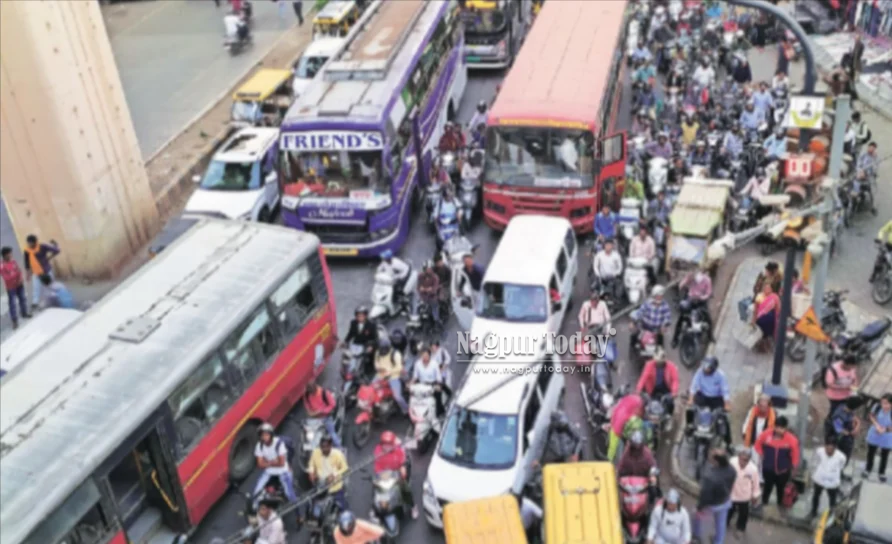 Nagpur is changing fast. Big flyovers, wide roads, and long concrete bridges are popping up all over the city. It looks like great progress, but when you look past the fresh roads and look at the real numbers, a big question comes up. Is all this spending on big roads really solving our traffic problems, or is it pushing our city and country into heavy debt while basic public services get ignored?
कागज़ पर तरक्की, ज़मीन पर कर्ज़
Building thousands of kilometers of highways and city flyovers costs huge money. Between 2014 and 2022, the total debt of the National Highways Authority of India grew nine times, jumping from ₹24,000 crore to nearly ₹3.5 lakh crore.
Instead of showing this directly in the main government budget, much of this money was borrowed through special bonds with government support. This hides the real debt burden, but in the end, common citizens have to pay it back through high toll charges and taxes for many years. Even though the government is now selling road rights to private funds to clear this debt, the main truth stays the same: we are enjoying today’s roads on money borrowed from tomorrow, creating a severe debt trap for the younger generation.
सड़कों के नाम पर शिक्षा का बजट स्वाहा
While big money is spent on concrete roads, public spending on education has slowly gone down. Government spending on education has dropped over the last ten years, falling from around 4.6 percent of the total budget to nearly 2.5 percent. Total public investment in education is still around 3 to 4 percent of GDP, which is way below the national goal of 6 percent.
We can see this clearly in Nagpur. While fancy flyovers are built across the city, government schools, local universities, and research centers struggle for basic funds, proper teachers, and good labs. Cutting down on education money to build concrete roads trades away our children’s future for short-term steel and asphalt.
पहली बारिश में ही उधड़ती सड़कें और गिरते पुल
Paying a high price would still make sense if these roads lasted for a long time. Sadly, news of brand-new highways breaking or washing away in the very first monsoon has become very common. Bridges fall down even before or just after opening, and smooth new roads quickly turn into dangerous pothole tracks.
This happens because the system rewards fast work instead of good quality. Private contractors take on more projects than they can handle, leading to rushed work, poor soil packing, and cheap materials. Quality checks are often just quick visual checks instead of proper structural tests. When a road breaks in a few months, citizens pay twice, first at the toll booth, and again through tax money spent on quick repairs.
सड़कें हमारी, लेकिन तेल बेगाना
Building more roads without a proper public transport plan has a major flaw because it uses up too much fuel. Bigger roads encourage more people to buy private two-wheelers and cars. India already buys nearly 90 percent of its crude oil from other countries.
This creates a dangerous money trap. We borrow money to build roads, and then spend billions of dollars in foreign currency to buy the petrol and diesel to run vehicles on them. Whenever global oil prices go up or wars break out abroad, our foreign money reserves take a hit and the rupee becomes weaker. Highway growth without good local public transport only increases our foreign fuel bill.
गन्ने की सब्सिडी और कृषि प्राथमिकताओं का भ्रम
To reduce foreign oil imports, the government is pushing hard for E20 ethanol blending, which means mixing 20 percent sugarcane ethanol into petrol. Rich countries that use crop fuels successfully have huge extra food production, diverting crops to fuel because they produce far more food than their people can eat.
India’s situation is completely different because we face a big food import problem. We import over 50 percent of our daily cooking oil and over 4.7 million tonnes of pulses recently just to meet basic food needs.
Despite these food shortages, sugarcane, which is used to make ethanol, gets huge government support through guaranteed prices, subsidized electricity, and cheap canal water, along with a national fertilizer subsidy bill of ₹1.6 lakh crore to ₹1.9 lakh crore every year.
This policy creates a big problem in Vidarbha. Sugarcane is not a natural crop for the dry lands of Vidarbha, which traditionally grows cotton, soybean, and pulses. Driven by ethanol incentives and sugar factories, sugarcane farming has spread into dam areas across Bhandara, Gondia, Wardha, Yavatmal, and parts of Nagpur district. Making just one liter of sugarcane ethanol uses nearly 3,000 liters of water. In a dry region like Vidarbha, using precious dam water and underground water to grow crop fuel while importing basic food items from outside is a huge waste of land and water.
ईथनॉल का गणित: छोटा फायदा, बड़ा नुकसान
The central government claims that ethanol blending has delivered a massive win by saving around ₹1.98 lakh crore in foreign exchange through reduced crude oil imports, but looking at the full economic balance sheet reveals that this paper profit simply masks heavy long-term public losses. When you calculate the net financial gain, subtracting the ₹4,687 crore ethanol interest subsidy, the massive share of the ₹1.6 lakh crore to ₹1.9 lakh crore annual national fertilizer subsidy spent on sugarcane, state power subsidies, and guaranteed mill payouts, the actual monetary benefit to the public treasury shrinks drastically. What looks like a profit on paper is further wiped out when common vehicle owners pay higher fuel bills from reduced E20 mileage ( 3 to 6%) and rising engine repair costs. Most critically, the catastrophic losses of water usage cannot be evaluated in money terms, and burning billions of liters of irreplaceable groundwater in drought-prone regions like Vidarbha to run cars turns any small financial claim into an ecological disaster.
नागपुर मेट्रो, एफएसआई (FSI) का खेल और बढ़ता ट्रैफिक
To really cut fuel use and save foreign money, the real answer is a smooth and affordable public transport system. Nagpur took a big step by starting the Nagpur Metro. The clean elevated lines connecting Sitabuldi, Khapri, Prajapati Nagar, and Hingna show great engineering.
However, bad urban planning has turned this Metro project into a profit machine for builders while making road traffic worse. Under Transit-Oriented Development rules, builders along the Metro line are given extra Floor Space Index up to 4.0 FSI. This allows them to build very tall, crowded commercial and residential buildings within 500 meters of Metro stations.
On paper, planners thought people living near Metro stations would not use personal cars. In reality, because the Metro does not have proper feeder buses or safe footpaths, commuters still rely on their own two-wheelers and cars. These tall buildings are made with relaxed parking rules, so they don’t have enough parking space, forcing visitors and residents to park illegally on main roads. As a result, roads like Wardha Road, Central Avenue, and West High Court Road are jammed with double-parked vehicles, leading to daily traffic jams and more road accidents near Metro zones.
अमीरों की सवारी ही असली मेट्रो की कसौटी
There is a famous saying in city planning that a developed city is not where poor people use cars, but where rich people use public transport.
This simple truth shows where Nagpur’s transport plan is failing. Right now, the Nagpur Metro is seen as a travel option for students or lower-income commuters who have no other choice. Meanwhile, rich professionals, business owners, and middle-class families avoid the Metro and drive their private cars and SUVs, clogging our roads and burning imported fuel.
Public transport works well only when it is faster, cleaner, more comfortable, and more respectable than driving a private vehicle. When a metro system works smoothly, featuring air-conditioned stations, reliable feeder buses right outside, and safe footpaths, everyone wants to use it, no matter how rich they are. By failing to build a system that makes rich people leave their cars at home, Nagpur’s Metro fails its main test. Private cars stay as a big status symbol, leading to endless traffic jams, parking fights, and rising fuel imports.
इमारतों से पहले इंसान बनाने होंगे
Building roads is important, but counting highway kilometers, giving extra FSI to builders, and making big flyovers cannot be the main proof of success. The real test of infrastructure is whether it makes daily life cheaper, protects our natural water, and pays for itself over time.
Spending public money on heavy road debt while cutting education funds, wasting water on fuel crops in Vidarbha, giving unchecked building rights to developers, and leaving public transport incomplete is a narrow sighted approach. Short-term profits cannot cover up long-term damage. If Nagpur wants to be a smart example for modern India, our leaders must stop focusing only on widening roads and helping builders. We must focus on educating our children, enforcing strict parking rules, saving our water, and building a comfortable public transport network that even the richest citizen chooses to ride every single day.
The original article was published on %%sitedesc%%. Read more: %%permalink%%

Asked once. After this the app never asks you for a city again.
Bengaluru was guessed from your connection. Nothing was set anywhere.
No account. No email. Nothing is shared. Pick your areas later, from You.

The Bengaluru edition, on your home screen.
Two taps in Safari. No App Store, no account.
You are following this story.